
Autoimmune conditions affect millions of people and include a wide range of diagnoses such as Hashimoto’s thyroiditis, rheumatoid arthritis, lupus, psoriasis, Sjögren’s, multiple sclerosis, celiac patterns, and inflammatory bowel conditions.
At first glance, these conditions appear unrelated. One affects the thyroid, another the joints, another the nervous system, and another the digestive tract.
Yet when we step back and look at the underlying biology, a very different picture emerges.
In many cases, these conditions are not separate issues at all. They are variations of the same underlying immune process—a loss of proper immune regulation that causes the body’s defense system to target its own tissues.
The immune system is designed to protect us. But when immune signaling becomes dysregulated, that protection can become misdirected.
Understanding this shared physiology helps explain why autoimmune conditions can look so different on the surface, yet arise from remarkably similar biological patterns beneath.
One Process, Many Different Targets
Although autoimmune conditions are classified by the tissues they affect, the underlying immune activity often follows a similar pattern.
In some individuals the immune system targets joint tissue.
In others it reacts to thyroid proteins.
In still others it affects the nervous system, skin, or digestive tract.
The target may differ, but the process driving the reaction is often the same.
Immune signaling becomes amplified, regulatory mechanisms weaken, and inflammatory pathways remain active longer than they should. Over time, this misdirected immune activity can begin reacting against tissues that would normally be ignored.
Understanding this pattern helps shift the conversation away from focusing only on one organ and toward understanding the broader regulatory systems that influence immune behavior.
What Happens Inside the Immune System
The immune system operates through a complex network of signaling pathways designed to maintain balance between defense and tolerance.
One of the most important regulatory relationships occurs between regulatory T-cells (Tregs) and inflammatory helper T-cells known as Th17 cells.
Under normal conditions, these two forces remain balanced.
Treg cells function as moderators of the immune response. They help maintain tolerance toward the body’s own tissues and prevent excessive immune reactions.
Regulatory T-cells (Tregs) function as moderators of the immune response. They help maintain tolerance toward the body’s own tissues and prevent excessive immune reactions. *Research has shown that disruptions in regulatory T-cell signaling are associated with the development of multiple autoimmune diseases, highlighting their central role in maintaining immune tolerance.
Th17 cells serve a different purpose. They are designed to respond aggressively to pathogens such as bacteria and fungi.
When immune regulation begins to shift, Th17 activity may increase while Treg regulation weakens. This imbalance can create an inflammatory environment where immune cells begin reacting to proteins that originate from the body itself.
The diagram below illustrates how naïve T-cells differentiate into several immune pathways, including regulatory and inflammatory responses that influence cytokine signaling and tissue inflammation.
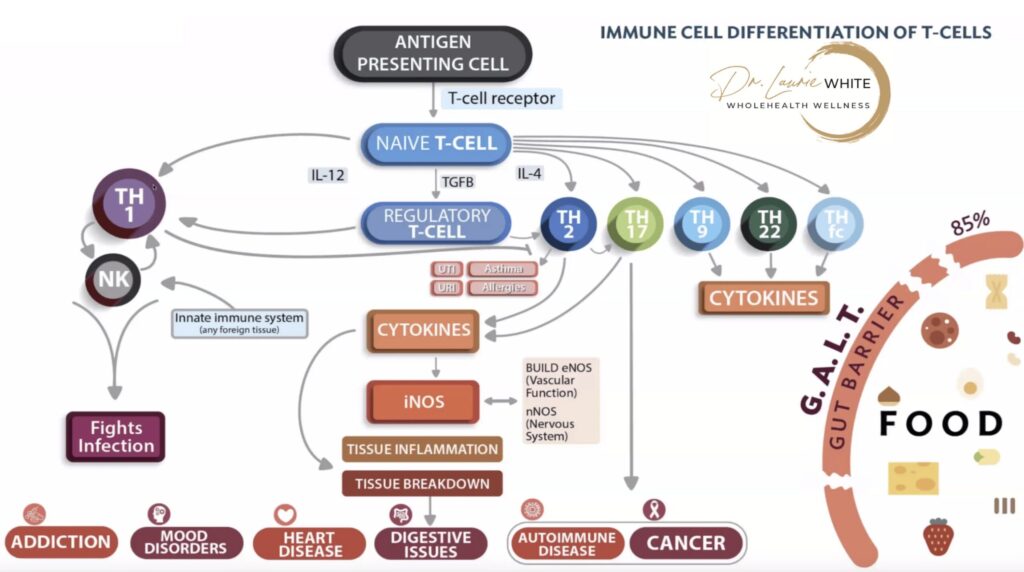
Figure: Simplified illustration of T-cell differentiation and cytokine signaling pathways that influence immune regulation, inflammation, and autoimmune disease development.
Another key pathway involved in immune activation and inflammatory signaling is NF-κB.
NF-κB acts as a master switch for inflammatory gene expression. When activated, it stimulates the production of inflammatory cytokines such as:
• IL-6
• TNF-α
• IL-1β
These signaling molecules amplify immune responses and help coordinate defense against infection. However, when this pathway remains chronically active, inflammatory signaling may persist even when no infection is present.
Over time, this persistent activation can contribute to the loss of immune tolerance.
The Gut–Immune Connection
A large portion of the immune system resides within the digestive tract, where the body constantly interacts with microbes, food particles, and environmental compounds.
The intestinal lining acts as a selective barrier between the contents of the digestive tract and the bloodstream. When this barrier becomes compromised—sometimes referred to as increased intestinal permeability—larger molecules and microbial fragments may pass into circulation.
These molecules can activate immune receptors and inflammatory pathways, including signals that influence Th17 immune activity and NF-κB signaling.
Repeated immune stimulation from the gut may contribute to broader immune reactivity in susceptible individuals. For this reason, the integrity of the intestinal barrier and the balance of the microbiome are increasingly recognized as important factors in immune regulation.
The Autoimmune Cascade
Although each autoimmune condition presents differently, the underlying pattern often follows a similar sequence.
Trigger
↓
Barrier stress (gut, environment, infection)
↓
Immune dysregulation
↓
Chronic inflammatory signaling
↓
Tissue targeting
This cascade helps explain why seemingly unrelated autoimmune conditions often share common contributing factors.
Why Autoimmune Conditions Affect Women More Often
Autoimmune conditions occur significantly more often in women than in men.
Researchers estimate that roughly three-quarters of autoimmune diagnoses occur in females, suggesting that hormonal and genetic influences play an important role in immune regulation.
Estrogen interacts with several components of the immune system, influencing immune cell activity, cytokine signaling, and antibody production. In balanced amounts, estrogen helps coordinate immune responses.
However, the relationship between estrogen and immune regulation is complex. Both elevated estrogen signaling and declining estrogen levels can influence inflammatory pathways.
During reproductive years, higher estrogen exposure may amplify immune responsiveness in some individuals. During perimenopause and menopause, declining estrogen levels may reduce certain regulatory signals that normally help restrain inflammatory pathways such as NF-κB.
Rather than a simple relationship of “more” or “less,” the key factor appears to be hormonal balance and immune modulation.
Chronic Infections and Immune Confusion
Another factor receiving increasing attention in autoimmune research is the role of chronic infections.
Certain microbes can trigger immune responses that persist long after the initial infection has resolved. In some cases, microbial proteins resemble proteins found within human tissues.
This phenomenon, known as molecular mimicry, can create confusion within the immune system. Immune cells initially target the infection but later begin reacting to similar-looking structures within the body.
Several infections have been studied in connection with autoimmune patterns, including:
• Epstein–Barr virus and other latent herpesviruses
• Lyme-related infections (Borrelia burgdorferi and associated co-infections such as Bartonella and Babesia)
• chronic viral reactivation (such as Epstein–Barr virus reactivation, cytomegalovirus (CMV), and human herpesvirus-6 (HHV-6))
• certain bacterial infections (such as Streptococcus species, Mycoplasma pneumoniae, Helicobacter pylori, and Chlamydia pneumoniae)
Epstein–Barr virus (EBV), a common virus that establishes lifelong latency in B-cells, has been strongly associated with autoimmune diseases such as multiple sclerosis. A large longitudinal study involving over 10 million individuals found that EBV infection increased the risk of developing multiple sclerosis by more than thirty-fold.
Chronic infections can also maintain prolonged immune activation. When inflammatory pathways such as NF-κB remain active, cytokine signaling continues and immune regulation may gradually shift.
For many individuals, autoimmune conditions appear not from a single trigger but from multiple physiological stressors accumulating over time.
Why Autoimmune Conditions Are Increasing
Over the past several decades, autoimmune conditions have become far more common.
While genetics play a role, our genes have not changed significantly in such a short period of time. What has changed dramatically is our environment and lifestyle.
Several factors are thought to influence the rising prevalence of immune dysregulation:
• changes in the microbiome due to antibiotics, medications and diet
• increased exposure to environmental chemicals
• chronic stress and disrupted sleep patterns
• ultra-processed foods and nutrient depletion
• persistent low-grade inflammation
These factors can influence the gut microbiome, inflammatory signaling pathways, and immune regulation.
Over time, the cumulative burden of these influences may place increasing stress on the systems responsible for maintaining immune balance.
When Symptoms Appear Long Before Diagnosis
Autoimmune conditions rarely appear suddenly.
For many people, subtle symptoms may develop years before a formal diagnosis is made. These early patterns are often nonspecific and easy to overlook.
Individuals may notice shifts in energy, digestive changes, intermittent joint discomfort, skin sensitivity, or increased sensitivity to stress.
These symptoms can arise for many reasons and do not necessarily indicate an autoimmune condition. However, they may reflect early shifts in immune signaling, inflammatory regulation, or barrier function.
Recognizing these patterns simply provides an opportunity to explore the underlying physiology more closely.
Understanding these patterns is one reason I developed the ANCHOR Method™, a structured framework that looks at the systems most responsible for regulating immune balance.—environmental influences, nervous system regulation, cellular energy, metabolic handling, microbiome health, and long-term resilience.
Rather than focusing on a single organ or diagnosis, this approach examines how these systems interact and how shifts in one area can influence immune behavior in another. You can learn more about the ANCHOR Method™ here.
Where Does Someone Begin?
One of the most common questions people ask when exploring autoimmune conditions is where to begin.
Because immune regulation involves multiple systems in the body—including the gut, nervous system, endocrine system, and cellular energy pathways—a structured evaluation can be helpful.
Laboratory evaluation may explore areas such as inflammatory markers, immune antibodies, nutrient status, metabolic regulation, gut health, and environmental exposures.
The goal is not simply to identify a label but to better understand the physiological patterns that may be influencing immune behavior.
Addressing the Underlying Patterns
While each case is unique, addressing autoimmune conditions often involves supporting several key areas of physiology.
Reducing inflammatory triggers, supporting gut barrier integrity, improving nutrient status, restoring metabolic balance, and strengthening stress resilience are common areas of focus.
When these systems begin functioning more efficiently, the immune system often gains the regulatory signals it needs to move back toward balance.
Rather than focusing on a single organ, this approach looks at the broader systems that influence how the immune system responds to infection, environmental exposures, and physiological stress.
A Final Perspective
Autoimmune conditions can feel confusing and overwhelming, especially when symptoms affect multiple areas of health or when answers are slow to emerge. The labels themselves—Hashimoto’s, lupus, rheumatoid arthritis, multiple sclerosis—can sound very different from one another.
Yet when we look beneath those labels, many autoimmune conditions reflect a similar biological pattern: the immune system has lost some of its regulatory balance and begun reacting in ways it normally would not.
Understanding this physiology changes the conversation. Instead of viewing autoimmune conditions as isolated problems affecting a single organ, we can begin looking more closely at the broader systems that influence immune behavior—gut health, inflammatory signaling, environmental exposures, hormonal balance, stress physiology, and cellular energy regulation.
The goal is not simply to suppress symptoms, but to better understand why immune regulation may have shifted in the first place.
For many individuals, the process of investigating these underlying patterns can provide valuable insight into how the body is responding to stress, infection, environmental influences, and metabolic demands.
And when those systems begin moving back toward balance, the immune system often follows.
That is where meaningful progress begins—not by chasing symptoms alone, but by understanding the deeper biological patterns shaping immune health.
Your immune system restores balance when its signals support regulation—not self-targeting.
Grab your complimentary copy of Your Genes, Your Journey here.
Interested in identifying what may be influencing your immune system?
Schedule A Complimentary Call With Dr. White.
