
A glass of red wine. A plate of aged cheese. Leftovers from a few days ago. Fermented foods that are supposed to be “good for your gut.”
For one person, these foods may cause no problem at all. For another, they may be followed by a headache, flushing, itching, congestion, bloating, digestive upset, heart palpitations—or simply the frustrating feeling that something they ate made them feel terrible.
And sometimes food isn’t the only thing contributing.
Seasonal allergens, mold exposure, gastrointestinal health, hormonal changes, medications and even physiological stress can all influence the larger picture.
When seemingly unrelated symptoms begin appearing across several different body systems, histamine intolerance may be one piece of the puzzle.
But histamine itself is not the enemy.
Histamine is a naturally occurring compound that the body needs. The problem may develop when histamine exposure and production begin to exceed the body’s ability to adequately metabolize and clear it.
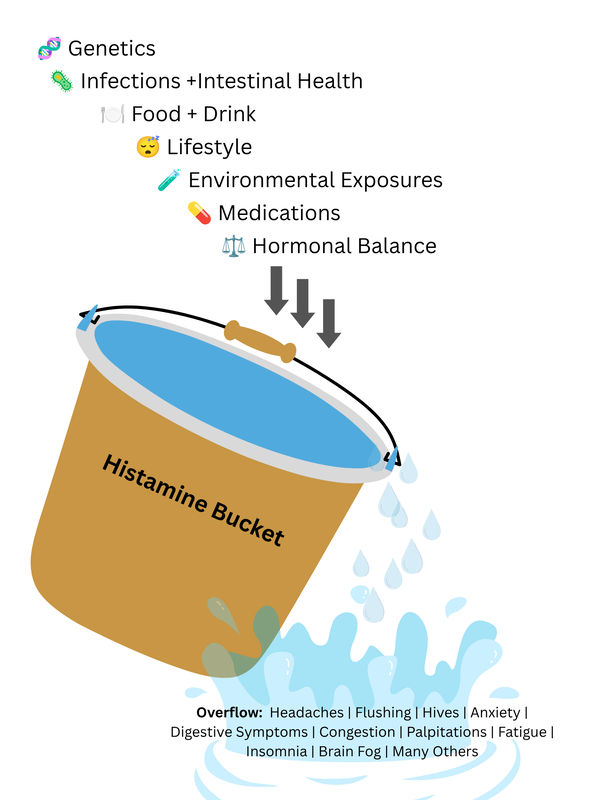
One way to visualize this is as a histamine bucket.
The body continually adds to and removes from that bucket. Symptoms may begin when the bucket is filling faster than it can be emptied.
And importantly, what is filling that bucket can be very different from one person to another.
First, What Is Histamine?
Most people associate histamine with allergies—and for good reason. Histamine is stored and released by mast cells and basophils and plays an important role in allergic and inflammatory responses.
But histamine does much more than make your nose run.
It communicates through four different histamine receptors located throughout the body and participates in immune signaling, stomach-acid secretion, vascular regulation, wakefulness and nervous-system activity.
That wide distribution helps explain why changes in histamine signaling can potentially produce symptoms that appear completely unrelated.
Histamine can come from several places.
Our own cells make it. Certain microorganisms within the intestinal tract are capable of producing it. And histamine is present in varying amounts in foods—particularly foods that have been fermented, aged, processed or stored for longer periods of time.
Fortunately, the body also has systems designed to break histamine down.
Two particularly important enzymes are diamine oxidase, or DAO, and histamine-N-methyltransferase, or HNMT.
DAO is especially important for breaking down extracellular and dietary histamine and is highly expressed within the intestinal tract. HNMT primarily metabolizes histamine within cells.
When histamine production and exposure remain reasonably balanced with metabolism, histamine performs its normal physiological roles.
When that balance changes, symptoms may begin.
What Does Histamine Intolerance Feel Like?
This is where histamine intolerance becomes both interesting and frustrating.
There isn’t one classic presentation.
Because histamine receptors are distributed throughout the body, reported symptoms may involve several different systems.
Symptoms can include:
- Bloating, abdominal discomfort, nausea, diarrhea, constipation or fullness after eating
- Itching, flushing, redness, hives or swelling
- Nasal congestion, sneezing or a runny nose
- Headaches or migraines
- Dizziness
- Heart palpitations or a rapid heartbeat
- Changes in blood pressure
- Sleep disruption or feeling unusually “wired”
- Hormonal or menstrual patterns in some women
Digestive symptoms are particularly common in the literature, but individual presentations vary greatly.
And that variability is important.
A headache after drinking wine does not automatically mean someone has histamine intolerance.
Neither does bloating after eating tomatoes.
Neither does itching after eating fermented food.
These symptoms can occur with many other conditions.
What becomes more clinically interesting is the pattern: recurring symptoms, sometimes affecting multiple body systems, that seem connected to particular foods, environments, hormonal changes, allergy seasons or other exposures.
Why Can Histamine Show Up So Strongly in the Skin?
The skin deserves some special attention because histamine-related skin symptoms can look remarkably different from one person to another.
Some people develop obvious hives. Others experience flushing, redness, swelling, itching or skin that suddenly feels unusually reactive.
When mast cells within the skin release histamine, it can act on nearby blood vessels and sensory nerves. Histamine contributes to vascular dilation, redness, swelling and the sensation of itch.
But histamine is not the only mediator involved in skin inflammation.
Cytokines, neuropeptides, immune cells, the skin barrier and other inflammatory signaling pathways may also play important roles.
That distinction matters because not every itchy rash, eczema flare or episode of redness is histamine intolerance.
Skin symptoms may be associated with allergy, dermatitis, infection, environmental exposure, hormonal changes, autoimmune processes, mast-cell disorders and many other conditions.
From a functional medicine perspective, however, the skin can give us valuable information.
Instead of looking only at what is happening on the surface, we can begin asking what may be happening underneath it.
What is occurring within the immune system?
What is happening in the gastrointestinal environment?
Are hormones influencing the pattern?
Are environmental exposures contributing?
And what is happening within the nervous system?
That becomes especially interesting when skin symptoms change alongside digestive issues, stress, food reactions or seasonal exposures.
The skin is such a large conversation of its own that we will return to it in a future article.
Why Would Someone Suddenly Become Sensitive to Histamine?
This may be the more important question.
Simply identifying foods that contain histamine doesn’t explain why someone who ate those foods without difficulty for years suddenly begins reacting to them.
This is where we need to look deeper.
The Gut
The intestinal tract deserves particular attention because DAO is highly expressed in intestinal tissue.
Gastrointestinal inflammation, intestinal disease or damage to the intestinal mucosa may potentially interfere with normal histamine metabolism.
The microbiome may also play a role.
Different microorganisms interact with histamine differently. Some bacterial species can produce histamine, while the larger microbial environment may influence intestinal and immune function.
This doesn’t mean every person with histamine symptoms needs an aggressive “gut protocol.”
It means the gastrointestinal environment belongs in the investigation.
Alcohol
Alcohol may add to the histamine burden in several ways. Some alcoholic beverages contain histamine and other biogenic amines, and alcohol may also interfere with histamine degradation.
This is one reason wine is such a commonly reported trigger.
Medications
Medication history matters as well.
Certain medications have been proposed to interfere with DAO activity or histamine metabolism.
This does not mean medications should be stopped because someone suspects histamine intolerance.
It means medication use should be reviewed as part of the larger picture with the appropriate practitioner.
Hormones
There also appears to be interaction among estrogen, mast cells and histamine signaling.
This may help explain why some women notice that symptoms change during the menstrual cycle, perimenopause or other periods of hormonal change.
Again, hormones may be one part of the load—not necessarily the entire explanation.
Fall, Mold and the Seasonal Histamine Load
Fall gives us another important piece of this conversation.
Mold exists year-round both indoors and outdoors, but outdoor mold exposure can become particularly noticeable as vegetation dies back and leaves begin to accumulate and decompose.
Mold spores float through the air much like pollen. According to the American Academy of Allergy, Asthma & Immunology, outdoor mold spores may peak during the fall in cooler areas and can remain present year-round in warmer regions.
Activities as ordinary as raking leaves or working around damp vegetation can increase exposure.
For people who are allergic to mold, inhaled mold spores can trigger an immune response. Mast-cell activation and histamine release can contribute to symptoms such as nasal congestion, sneezing, itchy or watery eyes, coughing, wheezing and skin symptoms.
Indoor mold introduces another consideration.
Plumbing leaks, roof leaks, flooding, damp basements, bathrooms with inadequate ventilation and high indoor humidity can all create an environment where mold grows.
The CDC emphasizes that when indoor mold is present, the important step is to correct the moisture problem and remove the mold, rather than relying on routine air sampling to determine whether action is needed.
This does not mean that mold exposure automatically causes histamine intolerance.
That would be too simplistic.
Instead, think again about the histamine bucket.
Food may be contributing to the load.
The gut may be contributing.
Hormonal changes may be contributing.
Then allergy season arrives and someone who is mold-sensitive experiences additional immune activation.
The bucket that was manageable before may now begin to overflow.
This may even help explain why certain people report becoming more reactive to foods during allergy season.
The food itself may not have changed.
The total physiological load may have changed.
This is why environmental history matters.
If symptoms seem to change with the seasons, worsen after yard work, appeared following water damage, or noticeably improve when someone is away from a particular environment, those details are worth paying attention to.
Sometimes the best functional intervention isn’t another supplement.
Sometimes it is finding the exposure and addressing the source.
Stress, the Nervous System and Histamine
Another piece of the histamine conversation is often overlooked: the physiology of stress.
We often think of stress as purely psychological.
But the body experiences many forms of stress.
Poor sleep, illness, inflammation, pain, unstable blood sugar, excessive exercise, emotional strain and chronic overstimulation all influence the body’s stress-response systems.
The nervous, endocrine and immune systems are in constant communication.
Research describes a bidirectional relationship between mast cells, basophils and the nervous system. Stress-related autonomic and endocrine signals can influence these immune cells and their mediator release. In the opposite direction, mediators released from mast cells and basophils—including histamine—can communicate with sensory nerves and contribute to processes such as itching and neurogenic inflammation.
In simple terms:
The nervous system can influence immune signaling, and immune signaling can influence the nervous system.
This does not mean histamine symptoms are “just stress.”
It means that chronic physiological stress may become another contributor in an already reactive system.
This is why nervous-system regulation can be an important part of a functional medicine plan.
Consistent sleep and wake times, morning daylight, appropriate exercise and recovery, balanced meals, slow breathing, prayer or meditation, time outdoors, periods of quiet and reducing constant stimulation all help create opportunities for the nervous system to shift out of persistent activation.
These practices do not replace treatment of allergy, gastrointestinal disease, mold exposure or a mast-cell disorder.
They support another layer of the physiology.
And sometimes that layer has been under strain for years.
Is Histamine Intolerance the Same as a Food Allergy?
No.
A classic food allergy involves an immune response to a specific food protein, frequently through IgE-mediated mechanisms.
Histamine intolerance is generally described as an imbalance between histamine exposure and the body’s ability to metabolize it.
Someone may therefore report symptoms after several unrelated histamine-containing foods without actually being allergic to those foods.
This distinction is extremely important.
Difficulty breathing, throat swelling, significant wheezing, fainting or symptoms of anaphylaxis should never be assumed to be “just histamine intolerance.”
Those symptoms require appropriate medical evaluation and emergency treatment when indicated.
What About Mast Cell Activation Syndrome?
Histamine intolerance and mast cell activation syndrome, or MCAS, are not the same condition.
Mast cells release histamine, but histamine is only one of many mediators they can release.
MCAS requires a different clinical assessment and involves evidence of episodic mast-cell mediator release along with an appropriate symptom pattern and treatment response.
This is another reason I am cautious about labeling every person with flushing, digestive symptoms, food reactions or itching as having “mast-cell activation.”
Histamine intolerance, IgE-mediated allergy, chronic urticaria, gastrointestinal disease and mast-cell disorders can overlap considerably.
Our job is to separate them as thoughtfully as possible.
Can We Test Histamine?
Yes—but this is where testing needs to be interpreted carefully.
We can measure histamine and several markers related to histamine metabolism or mast-cell activity.
What we cannot currently do is order one laboratory test that definitively tells us:
“This person has histamine intolerance.”
Histamine Levels
Histamine can be measured in blood, including plasma or whole blood depending on the laboratory.
But histamine is rapidly metabolized, and the result can be affected by timing, specimen handling and the circumstances surrounding the collection.
An elevated histamine value can therefore be useful information in the correct context, but it does not independently establish histamine intolerance.
Likewise, a normal result does not necessarily mean histamine is irrelevant.
I view it as another piece of data—not the entire answer.
DAO
DAO activity or concentration can also be measured.
Because DAO plays an important role in intestinal histamine degradation, a low DAO result may add useful information when the clinical picture fits.
But serum DAO testing has limitations.
Levels can vary within an individual, laboratory methods differ, and circulating DAO may not perfectly represent DAO activity within the intestinal mucosa.
DAO testing is therefore best interpreted alongside symptoms, exposures and other findings rather than being treated as a stand-alone diagnostic test.
Histamine Metabolites and Mast-Cell Markers
When the clinical picture raises concern for abnormal mast-cell activation rather than histamine intolerance alone, other markers may become useful.
Histamine is metabolized into compounds such as N-methylhistamine, which can be measured in urine.
Serum tryptase is an important marker when mast-cell activation is being evaluated. Depending on the clinical situation, urinary mediators such as N-methylhistamine, leukotriene E4 and prostaglandin metabolites may also provide useful information.
These are not simply additional “histamine intolerance tests.”
They are helping us ask a different question:
Is there evidence that mast cells are releasing abnormal amounts of mediators?
Allergy Testing
When the history suggests allergy—including reactions to foods, pollens or molds—skin-prick testing or allergen-specific IgE blood testing may also be appropriate.
Again, good testing is not about collecting as many abnormal values as possible.
It is about asking the right question with the right test.
So How Do We Know Whether Histamine Is Really the Problem?
This is where medicine becomes less tidy than the internet sometimes makes it appear.
There is currently no single validated biomarker for histamine intolerance.
That doesn’t mean testing isn’t useful.
It means laboratory results should be interpreted alongside the person’s history.
When did the symptoms begin?
What foods consistently precede them?
Are leftovers more problematic than freshly prepared foods?
Does alcohol reliably cause symptoms?
Do digestive symptoms and skin symptoms occur together?
Is there a hormonal pattern?
Do symptoms become worse during allergy or mold season?
Is there a history of water damage or persistent dampness?
Do symptoms worsen during periods of poor sleep or significant stress?
Are medications affecting the picture?
Is there underlying gastrointestinal disease?
And what happens when suspected triggers are temporarily removed and then thoughtfully reintroduced?
Sometimes a food, symptom and exposure diary reveals a pattern that one laboratory value never could.
This is a perfect example of where testing should support clinical reasoning rather than replace it.
A Functional Medicine Approach: Reduce the Load, Then Ask Why
If histamine appears to be contributing to symptoms, the goal should not be to spend the rest of your life afraid of avocado, tomatoes and yesterday’s chicken.
And it should not automatically be to purchase every bottle labeled “histamine support.”
The first question I want to ask is:
What is filling this individual’s histamine bucket?
That answer is highly individualized, and I like to work in phases to get to the root of the issues:
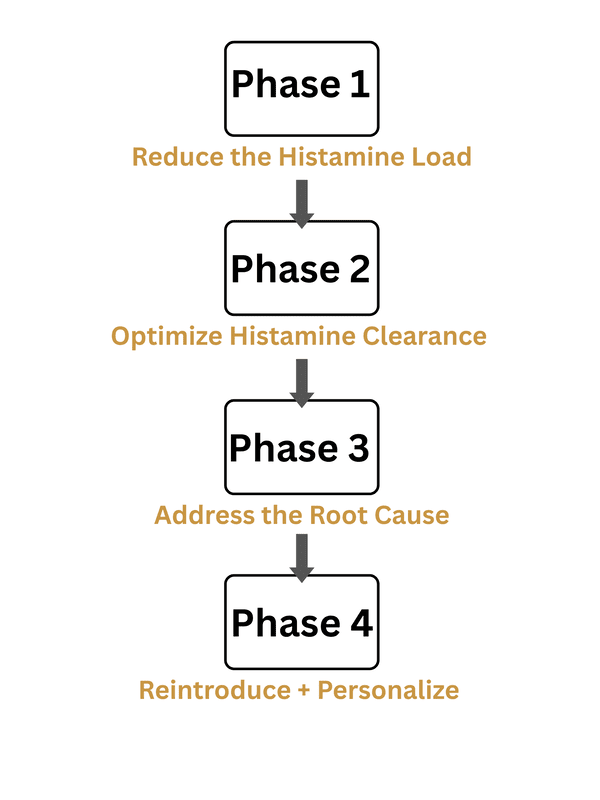
Temporarily Reduce the Dietary Load
A temporary lower-histamine diet can sometimes be a useful therapeutic and investigative tool.
Aged and fermented foods are among the more consistently recognized sources of dietary histamine.
Food freshness may matter as well because histamine and other biogenic amines can accumulate as bacteria act on foods during storage.
For someone who appears sensitive, preparing smaller quantities, refrigerating food promptly and freezing portions that will not be eaten soon may be more useful than simply memorizing an enormous forbidden-food list.
And those lists are notoriously inconsistent.
Foods commonly described online as “histamine liberators” do not all have the same level of scientific support.
The purpose of a temporary elimination is to identify tolerance and patterns—not to create an unnecessarily restrictive lifelong diet.
Look at the Gut
Because DAO activity is concentrated within the intestinal tract, digestive health needs to be part of the conversation.
If someone also has significant bloating, altered bowel habits, abdominal discomfort, food reactivity or signs of gastrointestinal dysfunction, I want to understand that environment rather than simply remove more foods.
This may involve evaluating digestion, intestinal inflammation, dysbiosis or other gastrointestinal conditions depending upon the person.
And this is one area where I would not automatically add a generic probiotic.
Different microorganisms interact with histamine differently. Some bacteria can produce histamine, and probiotic effects are strain-specific.
“Take a probiotic” is therefore not a personalized histamine strategy.
Reduce Meaningful Environmental Exposure
For someone with seasonal allergy or mold sensitivity, decreasing exposure can help lower one source of immune activation.
That might mean being thoughtful about outdoor exposure on high mold or pollen days, showering and changing clothes after extensive yard work, managing indoor humidity, fixing water leaks and addressing visible mold appropriately.
The goal is not environmental fear.
It is recognizing meaningful exposures when they are part of the individual’s pattern.
Support Nervous-System Regulation
Because of the communication between the nervous and immune systems, I also want to know what is happening with sleep, recovery and chronic stress physiology.
A person cannot supplement their way out of sleeping five hours a night, eating erratically, overtraining and living in constant sympathetic activation.
Foundational support still matters.
Consistent sleep, circadian light exposure, regular meals when appropriate, movement, adequate recovery, breathing exercises, meditation or prayer, time outdoors and creating actual periods of physiological quiet may all support a healthier balance between activation and recovery.
That doesn’t make them treatments for histamine intolerance.
It makes them part of creating an environment in which the body can regulate more effectively.
Nutrients and Supplements: Support Should Be Individualized
When appropriate, some of the supportive nutrients and compounds I may consider include DAO, quercetin, vitamin C and targeted correction of nutrient insufficiencies.
But this is where I want to emphasize something important:
There is no universal supplement protocol for histamine intolerance.
A person whose primary issue is mold allergy may need a very different plan from someone with reduced DAO activity. Gastrointestinal disease may call for an entirely different approach, while true mast-cell activation requires a different level of evaluation altogether.
Supplements can support the physiology, but they should not distract us from identifying what is actually creating the load.
DAO Enzyme Support
Supplemental DAO may be useful for selected individuals.
Oral DAO is intended to help metabolize histamine within the gastrointestinal tract and is generally used around meals rather than functioning as a systemic histamine blocker.
Small clinical studies have reported symptom improvement with DAO supplementation, but the available evidence remains limited and larger clinical trials are still needed.
This is why I think of DAO as a potential supportive tool, not the answer to every histamine problem.
Even when someone responds beautifully to DAO, I still want to ask:
Why did this person need additional DAO support in the first place?
That question takes us back to the gut, nutrition, medications, genetics and the larger clinical picture.
Quercetin
Quercetin is a plant flavonoid frequently used in functional medicine because of its antioxidant, anti-inflammatory and potential mast-cell-modulating properties.
Laboratory and preclinical studies suggest that quercetin can influence mast-cell degranulation and histamine release. Some human studies in allergic conditions are encouraging, but overall human clinical data remains limited.
So again, this is a possible supportive compound—not a diagnosis and not a cure.
Vitamin C and Other Nutrient Cofactors
Vitamin C may also be considered as part of broader nutritional and antioxidant support.
Vitamin C, vitamin B6, copper and zinc have all been discussed in relation to DAO activity and histamine metabolism, particularly when nutrient deficiency, malnutrition or restrictive diets are present.
But this does not mean everyone with suspected histamine intolerance should immediately supplement all of them.
Copper is necessary for normal physiology, but excess copper can also cause harm.
The same principle applies to vitamin B6: more is not always better.
This is why I prefer to ask:
Does this particular individual actually need the nutrient?
Correcting an insufficiency is very different from treating everyone with the same collection of supplements.
Review Alcohol, Medications and Hormonal Patterns
Sometimes the intervention isn’t something else that needs to be added.
Sometimes the biggest clue is already sitting in the history.
Alcohol may matter.
Medication use may matter.
Menstrual timing or perimenopausal changes may matter.
Sleep may matter.
Seasonal mold exposure may matter.
Gut function may matter.
And very often, it is not one thing.
It is the combined load.
There Is No Universal Histamine Protocol
This may be the most important part of the entire discussion.
One person’s histamine load may be largely dietary.
Another person’s symptoms may increase dramatically during mold or pollen season.
Someone else may have significant gastrointestinal dysfunction affecting histamine metabolism.
Another person may have medication effects, nutrient insufficiency, hormonal influences, chronic urticaria, a true food allergy or a mast-cell disorder.
Often several factors overlap.
This is why working with a practitioner who understands the larger physiology can be so valuable.
The question should not simply be:
“How do we lower histamine?”
We want to know:
Where is this person’s load coming from?
How well are they breaking histamine down?
Why are mast cells releasing it?
What is happening in the gastrointestinal environment?
What environmental exposures are contributing?
What role are hormones, medications, nutrient status and stress physiology playing?
And ultimately:
What does this particular person need?
Diet can be helpful.
Supplements can be helpful.
Nervous-system support can be helpful.
Environmental changes can be helpful.
Testing can be helpful.
But each should have a reason for being there.
The goal isn’t to create a lifelong low-histamine diet or a cabinet full of supplements.
Support the System, Not Just the Symptom
It would be easy to stop at:
Histamine gives me symptoms, therefore I need to avoid histamine.
But that may only address the top layer.
The deeper investigation asks why normal physiology has become less resilient.
Sometimes reducing dietary histamine helps while the system settles down. DAO, quercetin, vitamin C or another targeted nutritional strategy may also provide support when appropriate. In other cases, gastrointestinal dysfunction, allergy, mold exposure, medications, hormonal shifts or a mast-cell disorder may turn out to be more important than dietary histamine itself.
And sometimes chronic physiological stress is quietly adding to an already overloaded system.
There is no universal protocol because there is no universal reason someone’s tolerance changes.
The goal isn’t simply to make the histamine bucket smaller.
The goal is to understand what is filling it, why it is overflowing and, wherever possible, help the body regain its ability to manage the load.
That is where functional medicine can help us move beyond simply chasing the symptom and begin understanding the physiology underneath it.
Grab your complimentary copy of Your Genes, Your Journey here.
Ready to understand what may be driving your symptoms?
Schedule a Complimentary Call with Dr. White.

Sources + Further Reading
Comas-Basté O, Sánchez-Pérez S, Veciana-Nogués MT, Latorre-Moratalla ML, Vidal-Carou MDC. Histamine Intolerance: The Current State of the Art. Biomolecules. 2020;10(8):1181.
Jochum C. Histamine Intolerance: Symptoms, Diagnosis, and Beyond. Nutrients. 2024;16(8):1219.
Yoshikawa S, Nagao K, Toyama S, et al. Mast Cell/Basophil-Nerve Crosstalk: Autonomic Signals and Sensory Circuits. Frontiers in Bioscience-Landmark. 2026;31(7):51349.
Naso M, Trincianti C, Tosca MA, Ciprandi G. Quercetin and Its Lecithin-Based Formulation: Potential Applications for Allergic Diseases Based on a Narrative Review. Nutrients. 2025;17(9):1476.